Main Steps of Replacement
1. Project Assessment:
Consult a qualified professional to evaluate your current installation, estimate heating requirements, and recommend the most suitable heat pump for your situation.
This diagnostic step is crucial and should be as accurate as possible. To achieve optimal performance, consider improving home insulation. You can also engage in an overall renovation program, which is favored for financial incentives.
In some cases, radiators (or other heat emitters) may need to be replaced. However, note that intuis' high-temperature heat pumps are a suitable replacement for older boilers and do not require replacing high-temperature radiators in place.
2. Heat Pump Installation:
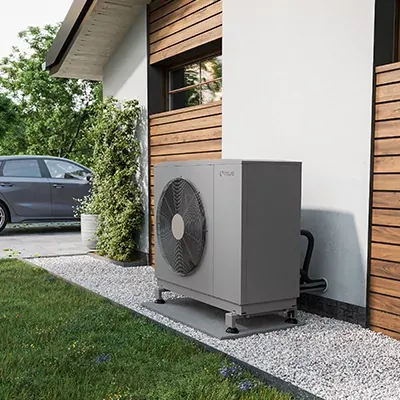
Once the heat pump is selected, the professional will proceed with its installation, taking into account your home's specificities and adhering to relevant regulations.
Depending on your home's characteristics, your installer may need to prepare a sizing note for your future heat pump, enabling the correct choice of its capacity. Manufacturers provide installers with tools to create this note, which is a legal requirement to qualify for renovation incentives. Don't hesitate to request it from your installer, as it provides details of the analysis performed. The efficiency of your future heating system depends on it.
Consider existing equipment and recycling. For long-term interventions, and for your comfort, the temporary installation of an electric backup boiler may be a welcomed service.
Before installing the heat pump, the water circuit should be cleaned, purged, and treated. The quality of the water circuit directly impacts the heat pump's performance and durability.
Several best practices should be followed, such as installing air vents at high points, fitting shut-off valves for circuit maintenance, having a correctly sized expansion vessel, a mud separator for sedimentation, a corrosion inhibitor, exogel valves, filters, and more. This array of equipment ensures the quality of a healthy, efficient, and durable installation.
3. Configuration and Parameterization:
The heat pump must be correctly configured and parameterized to adapt to your existing heating system and ensure optimal performance.
Configuration is performed via the controller during the commissioning process. This includes setting up the system, such as water temperature regimes, domestic hot water function, etc., and initiates a circuit purging program.
We recommend sending warranty registration forms to our services so that the equipment is registered, and the commissioning is carried out by an intuis Certified Technical Station professional to qualify for an extended warranty.
4. Monitoring and Maintenance:
Regular monitoring and annual maintenance of your heat pump are essential to ensure its proper operation and maximize its lifespan.
Heat pump maintenance is straightforward and involves cleaning filters and the evaporator. However, as with any hydraulic installation, regular checks of water circuit quality, air purging, water turbidity verification, desludging if necessary, and water level checking are essential.