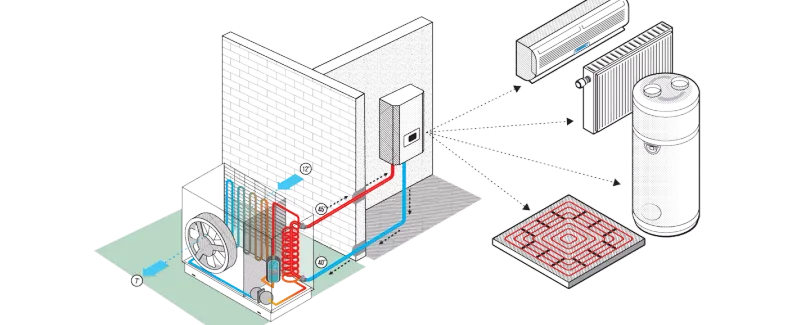





 How Does a Heat Pump Work?
A heat pump captures energy from an external source (air, water, or ground) using an evaporator, then raises the temperature of this thermal energy through a compressor, and finally transfers it, at the desired temperature, to the space that needs heating or cooling.
A heat pump operates similarly to a refrigerator and comprises four main components:
- Evaporator: This component transfers the heat extracted from the environment to the refrigerant fluid. To do this, the refrigerant must be colder than the external air. The expelled air is typically about 5°C cooler. It uses the evaporator's fins to allow heat to warm the fluid inside the heat pump's circuit, causing its evaporation.
- Compressor: The gaseous refrigerant is compressed to increase both pressure and temperature significantly. This is achieved through a compressor, which operates like a bicycle pump, heating the working fluid considerably as it transitions from low-pressure gas to high-pressure gas.
- Condenser: The condenser transfers the heat contained in the refrigerant to the hydraulic circuit. As a result, the refrigerant condenses, changing from a gaseous to a liquid state. The hydraulic connection benefits from this change in state by absorbing heat (about +5°C). It then travels from the heat pump to the indoor unit to heat the heating and domestic hot water circuit.
- Expansion Valve: The refrigerant's pressure is lowered, and it is significantly cooled down through an expansion valve (adiabatic expansion). The purpose is to recharge it with heat for the next cycle. The loop is complete.
The choice of refrigerant fluid is crucial in the process. In recent years, there has been a shift towards using R32 refrigerant, which is 70% less harmful to the environment. However, this gas remains quite polluting and is prohibited by the F-GAS regulation, which advocates for more natural fluids like R290 (propane). These alternatives do not contain HFCs (hydrofluorocarbons) and are 325 times less harmful to the environment. The degree of harm is measured by the Global Warming Potential (GWP), which is 3 for R290 and 675 for R32.
That's why Intuis made the forward-looking choice in 2010 to use R290 for its equipment.